
Access to the Atrostim portal is reserved for healthcare professionals.
By accessing and browsing this site, you certify that you are a healthcare professional.
An implantable phrenic nerve stimulation solution — an alternative and complement to assisted ventilation. Proven for over 30 years by Atrotech.

A major advance for thousands of patients with Central Sleep Apnea (CSA) who have failed or cannot tolerate positive airway pressure therapies.
In 2025, the AASM published updated clinical guidelines for CSA, including phrenic nerve stimulation (PNS) as a recommended therapeutic option for primary CSA and CSA associated with heart failure.
AASM recommendation (conditional): “The AASM suggests using phrenic nerve stimulation over no stimulation in adults with primary CSA and CSA due to heart failure who have failed other therapies.” Badr MS et al. J Clin Sleep Med. 2025;21(12):2181–2191
Atrostim PNS is an implanted diaphragm stimulation system based on the proprietary Sequential Multipolar Stimulation (SSM) technology. CSA is not a new indication: it falls within acquired central hypoventilation, for which Atrostim has been indicated and reimbursed in France since 2009.
Implanted phrenic nerve stimulation is a technique that is an alternative and/or complement to assisted ventilation. It triggers diaphragm contractions by electrically stimulating the phrenic nerves.


Benefits clinically demonstrated over decades of patient follow-up.

Enables independence from the ventilator — full or partial weaning.

Better lung ventilation, improved oxygenation, fewer respiratory infections.

Markedly improved quality of life for patients and their carers.
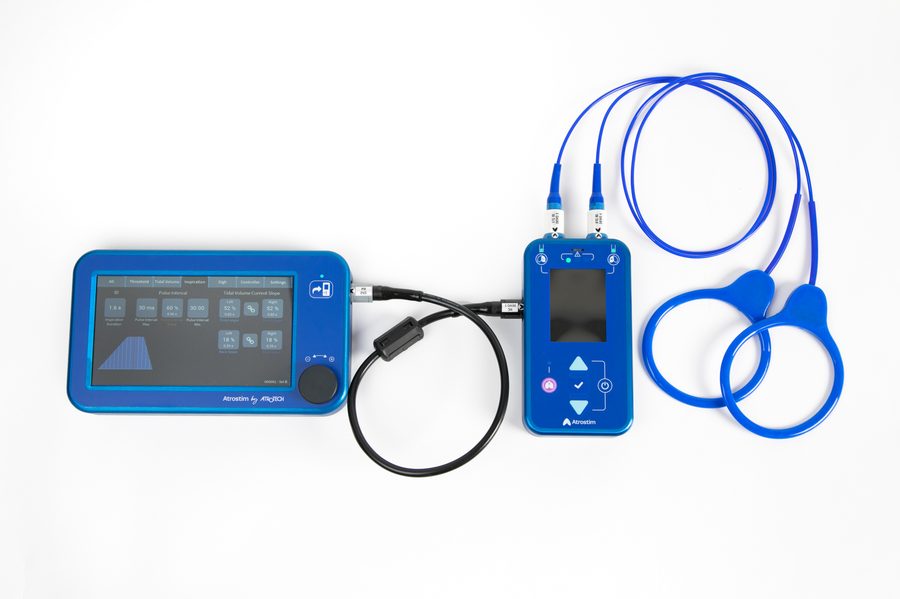
The stimulator reproduces the neurological signals that trigger diaphragm contractions and create the breathing cycle.

The controller triggers the programmed stimulation cycle.
Energy is transmitted by radiofrequency through the skin.
The phrenic nerve is stimulated in a targeted, sequential manner.
The diaphragm contracts and inhalation begins naturally.
Class III medical device — managed and regulated care from start to finish.

Patient and healthcare-professional booklets and a literature review available on request.
Implanted phrenic nerve stimulation — explanatory film
Implanted phrenic nerve stimulation triggers diaphragm contractions by delivering electrical pulses to the right and left phrenic nerves.

Pulses are delivered through two quadripolar electrodes that encapsulate the phrenic nerve — preventing long-term diaphragm muscle fatigue.

Stimulation distributed across several points of the nerve — preventing muscle fatigue.
Low current targeting only the phrenic nerve, without spreading to neighbouring nerves.
Radiofrequency signal through the skin — eliminating any infection risk from a percutaneous wire.
The medical team programmes three breathing-rate modes — low, medium, high — to suit the patient's activities.

Implanted phrenic nerve stimulation is indicated for patients dependent on ventilatory support whose phrenic nerves are functional.
Tetraplegic patients with high cervical spinal cord injury (C1-C2), dependent on continuous assisted ventilation.
Patients with CCHS (Congenital Central Hypoventilation Syndrome), with impaired central respiratory drive.
Any patient dependent on continuous or partial ventilatory support with intact, functional phrenic nerves.
Patients with repeated interruptions of central respiratory drive during sleep, with functional phrenic nerves.
Phrenic nerve stimulation requires a thorough assessment at a reference centre before any decision to implant.
A dedicated information booklet is available for patients and healthcare professionals.
Go to documentationBenefits demonstrated over decades of clinical follow-up and published in the international scientific literature.
Enables independence from the ventilator — full or partial weaning. Breathing by phrenic nerve stimulation is more physiological.
The lungs are better ventilated — improved oxygenation and a significant reduction in respiratory infections.

Up to 2.5× higher in patients with high spinal cord injury compared with assisted ventilation.
Markedly improved quality of life for patients and their carers since adopting phrenic nerve stimulation.

Natural speech can be restored and phonation made easier thanks to breathing by phrenic nerve stimulation.

Partial or full recovery of taste and smell — air passes through the nose during phrenic nerve stimulation.
Beyond the clinical benefits of phrenic nerve stimulation, Atrostim® offers unique technological advances developed by Atrotech.
A unique Atrotech innovation. Reduces the risk of muscle fatigue and preserves the integrity of the phrenic nerve over the long term.
Low-intensity stimulation targets only the phrenic nerve without spreading to the surrounding peripheral nerves.
RF transmission through the skin — eliminating any skin infection risk, a common complication of other systems.
Class III implantable medical device — every step is strictly governed by a regulatory protocol and a specialised reference centre.

Your doctor completes a medical questionnaire describing your general health, your artificial-ventilation conditions and your personal situation. This questionnaire is sent to the reference centre for analysis.

The reference centre performs a full work-up — respiratory and neurological — and external phrenic-nerve stimulation to confirm there are no contraindications.

Surgery is performed under general anaesthesia by video-assisted thoracoscopy — a minimally invasive technique lasting about two hours. The electrodes and receivers are implanted on the right and left phrenic nerves.

A few days in intensive care to monitor recovery. A transfer is then arranged to the diaphragm reconditioning unit.

Progressive training of the diaphragm over several weeks to create a near-natural breathing cycle and maximise weaning from the ventilator.

Before discharge, carers are trained to use the phrenic nerve stimulator and its various modes according to the patient's activities.

The reference centre's medical team provides regular follow-up — home set-up, tolerance to stimulation and adjustment of settings.
Information booklets for patients and healthcare professionals and a literature review — available by email on request.
All the information on implanted phrenic nerve stimulation for tetraplegic patients and their families.
Receive by emailInformation dedicated to patients with central alveolar hypoventilation and their families.
Receive by emailAimed at PRM physicians, pulmonologists, intensivists, neurologists and all healthcare staff involved.
Receive by emailA selection of the main scientific articles on implanted phrenic nerve stimulation published in the international literature.
Receive by emailThe group brings together two complementary entities: Tidalium, the French parent company, which drives the clinical, marketing and commercial strategy, and Atrotech, its Finnish subsidiary, which designs and manufactures the implants. Both entities share the same management, ensuring consistency and continuity from research to manufacturing, in the service of patients.

Tidalium is a French company and the parent of the group. It handles the worldwide marketing and commercialisation of the Atrostim PNS® implanted phrenic nerve stimulation system and drives all clinical, marketing and commercial activities related to the technology. The implants are designed and manufactured by its subsidiary Atrotech.


Atrotech Oy is the group's Finnish subsidiary, based in Tampere. Founded in 1984, it specialises in functional electrical stimulation and implantable neurostimulation. It manufactures the Atrostim implants in a cleanroom, in compliance with the requirements applicable to Class III medical devices.

For the spinal cord injury indication, Tidalium relies on a network of specialised distributors across Europe to provide follow-up and support to medical teams.
2, impasse des Cabanes, 34600 Les Aires
Tel.: 04 48 20 15 55
atrostim@tidalium.com
www.tidalium.com
An der Meil 4, 65555 Limburg a.d. Lahn
Tel.: +49 6431 94710
info@boergel-gmbh.de
www.boergel-gmbh.de
Mirador de la Sierra, 5 & 7, 28035 Madrid
Tel.: +34 913 735 248
anita@waas.es
LinkedIn
Skrzyneckiego 38, 04-563 Warsaw
Tel.: +48 22 812 48 41
imc@impomed.com.pl
www.impomed.pl
Our sincere thanks to Sébastien's parents and to Fabien for their trust and their testimony.
Testimony of a patient implanted with Atrostim PNS®

of patients prefer stimulation to the ventilator after implantation
implantations in France — zero phrenic nerve injuries
patients implanted worldwide — zero serious adverse events
Easier movement without an external ventilator — indoors and outdoors.
Better oxygenation, fewer tracheal suctions, sense of smell and taste restored.
100% of patients prefer stimulation to the ventilator after implantation.
Are you a patient, doctor or relative of an Atrostim patient? Your testimony is valuable to the medical community and to future patients.
Write to usFor any request for information about the Atrostim PNS® device, its indications, the documentation or to arrange a meeting.